This is Part I of a two-part post. (Part II goes up tomorrow.) Those who follow my Patreon may already be familiar with an early version of some of this, but it seems appropriate to discuss here, too.
The Pictish Stones are a pretty problem. Anderson and Allen’s 1903 classification1 into three basic types isn’t really very satisfactory:
- Class I = rough, undressed stone; animal imagery incised; Pictish symbols; no Christian imagery; assumed to be the oldest stones ranging from the sixth to eighth centuries
- Class II = worked (at least partially dressed) stone in the form of crosses; animal imagery carved in relief; includes both Pictish symbols and Christian imagery; assumed to be later, though perhaps overlapping Class I to a degree: eight to ninth century
- Class III = smooth, dressed stone; Christian imagery, no Pictish symbols; also supposedly eighth to ninth century
This classification comes from an old-fashioned perspective: a primitive-to-sophisticated progression of heathenism-to-Christianity for the Picts; it also assumes that all the stones were erected and carved by said Picts.
More recent scholarship points to deficiencies in that thinking. The first stones date from much earlier—perhaps even as early as the third century, possibly inspired by Roman stonework; the stones with Christian iconography could be as early as the sixth century; and the later stones may very well not be Pictish at all.2
Inverness Museum and Art Gallery (funded by the Highland Council) uses 4 categories (which I’ve numbered for ease-of-reference though they don’t use numbers):
- Incised symbol stones — pieces of natural undressed stone: The unique Pictish symbols were incised on the smoothest face of natural boulders. These date from the 6th century.
- Simple grave-markers — have a basic cross symbol. Again incised on natural stones, they date from the 7th century.
- Cross slabs — shaped and dressed stone, carved in relief, displaying elaborately decorated crosses, symbols and figurative scenes, (7th – 9th centuries).
- Christian monuments — cross-slabs, massive horizontal grave-markers, stone box shrines and internal architectural features, carved with the same range of designs as the symbol-bearing cross-slabs but without the symbols (8th – 9th centuries).
This makes more sense to me. As for the use and purpose of these stones… Are they religious or spiritual signs? Memorial markers? A system of writing? Or territorial and/or boundary and/or alliance markers? I simply have no idea. Though I suppose, if pushed, I might side with those who consider the paired symbols, at least, as indications of power/territoriality/ownership, with the symbols perhaps standing for names. These stones took work; they are statements. I just have no idea what they’re stating. And as this isn’t something I’m planning to write about in my fiction I’m fine with not knowing.
So if I have no plans to fold Pictish stones into my fiction, why am I writing about them here, in a research blog devoted to discussion of the thinking underpinning the creation of my novels of Hild of Whitby, Hild and Menewood?
I’m so glad you asked! And the answer is that I’m interested in the animal art as it relates to another project based on the zoomorphic art of Early Medieval manuscripts, metalwork, and sculpture. Which brings me hard up against my bias when it comes to Pictish Stones: I much prefer the so-called Class I and/or categories 1, 2, and perhaps a handful of the 3s: basically, I’m here for the animals.
Various people have made various lists of the animals carved into these stones. They’re difficult to categorise, mainly because it’s hard to tell which beasts are
- real, as in existing in nature, and realistically portrayed
- real but not very realistically portrayed
- mythical and/or imaginary.
Take, for example, the so-called ‘Pictish Beast’ which by itself accounts for about 40% of all animals represented on Pictish stones. Here’s a nineteenth-century sketch of a variety of Beasts from different stones of different classes/eras.
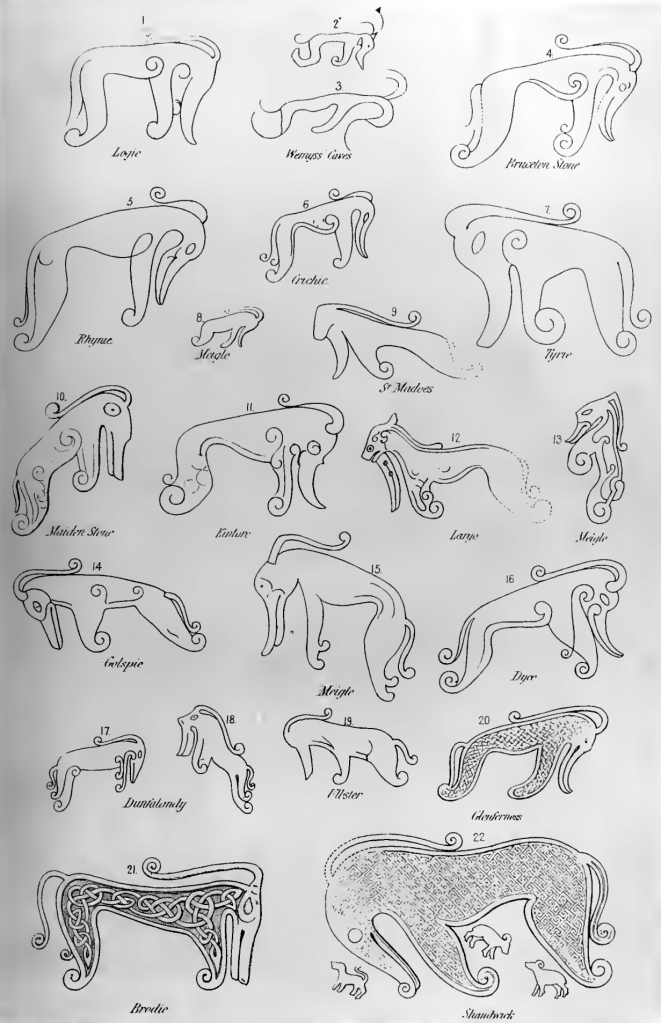
You can see the styles change with time and place, but clearly it’s a very specific beastie with very specific meaning whose essence stays stable over time. I tend to think of them as dolphins—just look at that nose/beak; and the topknot thing could be spume from a blow hole; the shape they often assume makes me think of something swimming, or at least hanging in the water—but no one really knows.
Even though this beast was clearly important (40%!), I had no urge to draw it, mostly because the pose also reminded me of something dead and hanging, the way for example, the official crest of the City of Leeds—known for its wool and wool trade—which is meant to be a fleece hanging to be weighed, but to me it looked like someone had just gored a lamb and hung it on a meat hook, always gave me the shudders. As a child, I saw it everywhere, every day.
For this project I wanted to draw living, breathing, (relatively) realistic animals. I did a lot of searching and found only a handful of recognisable species: horse, goose, bull, stag, snake, boar, salmon, and a bird that on some stones might be an eagle but on others seems more like a raven. And many are either very heavy and ponderous-looking (like the bull) or rather characterless (like the horse). As with manuscripts, though, the later the images were created, the more delicate and fluid (though, interestingly, often less realistic) they appear.
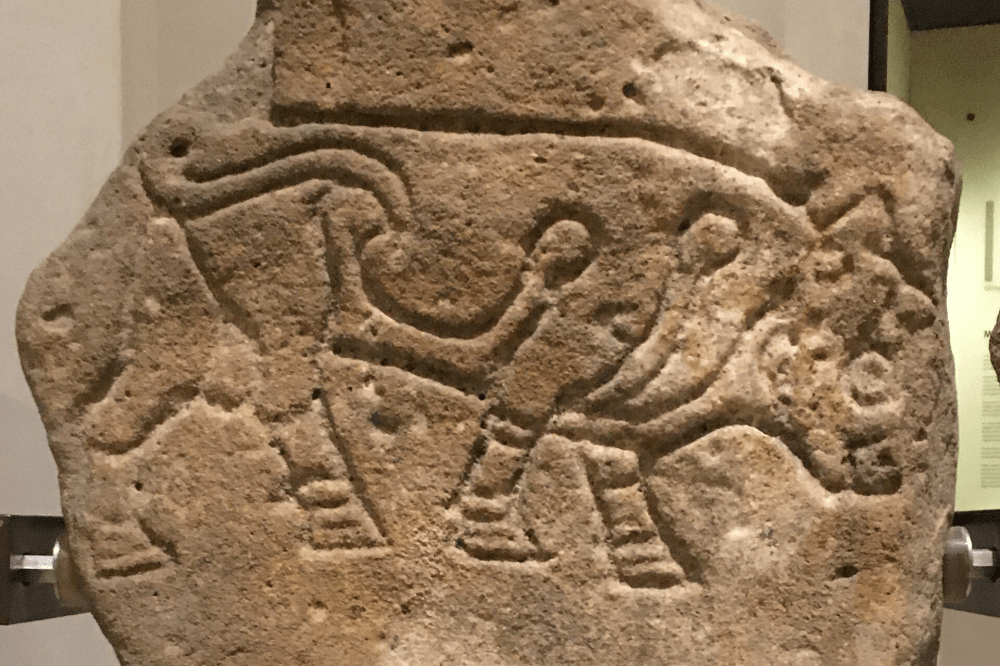
Here, for an example, in a bull, found on what I’d label a Category 1 stone, I’m guessing early seventh century, from Burghead:
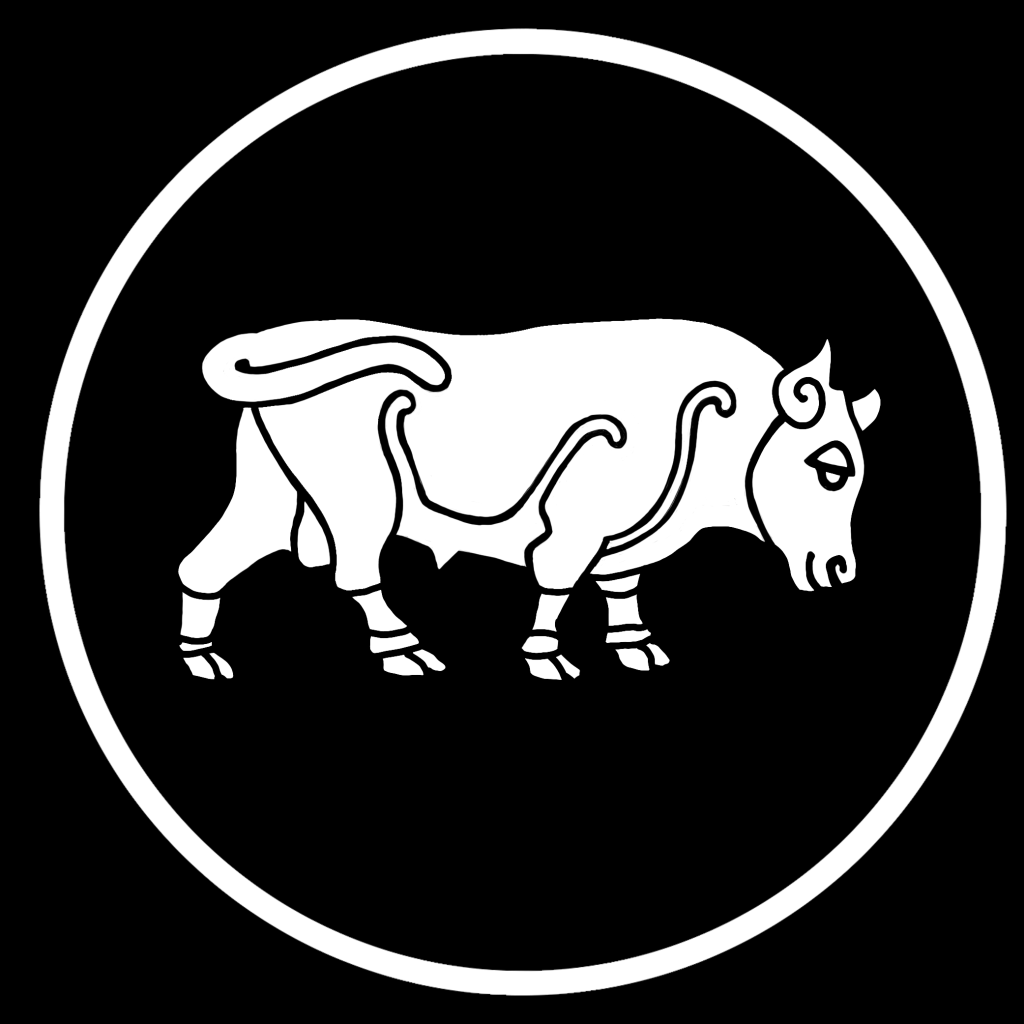
When I drew it, I make a reasonably faithful rendition, though couldn’t resist giving it slightly more natural curves, and changing the hooves and eyes:
The Aberlemno Stone—or at least the one I want to talk about, Aberlemno 2 (there are 5 of them, though only 4 are certainly Pictish)—is a cross slab, shaped, smoothed, and sophisticated.
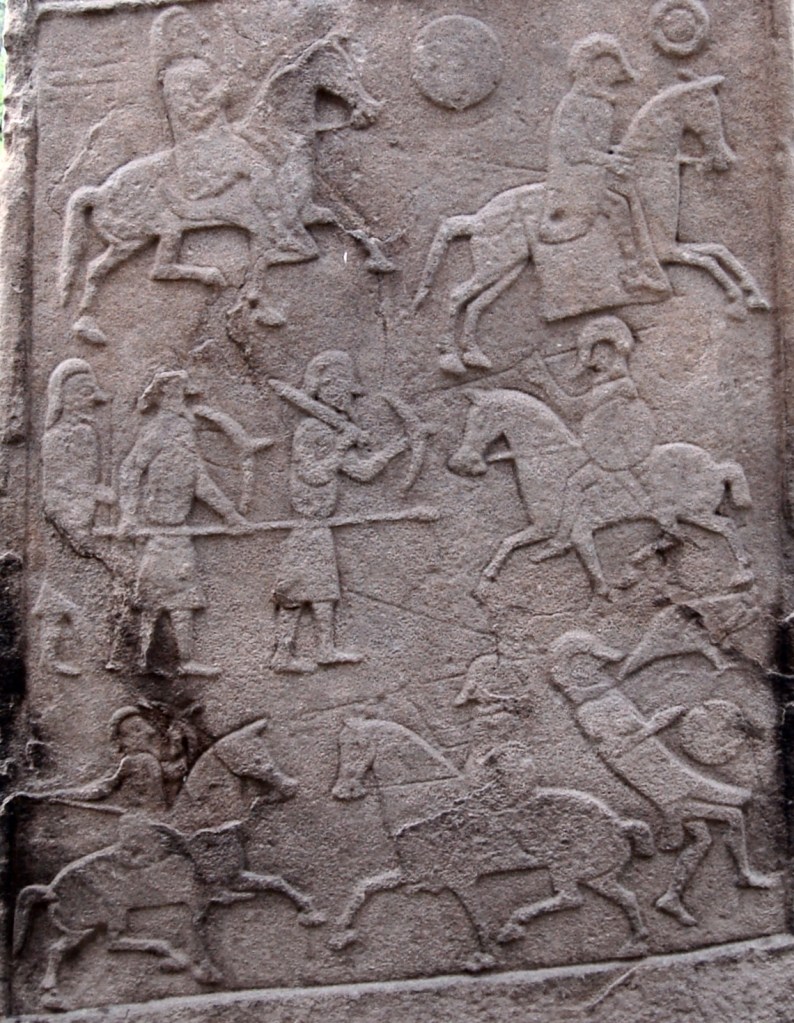
On the back of the stone is what I assume is a battle scene, included here so you can see how the horses were carved (on these stones the horses’ purpose seems to be to enhance the status of their riders; the horses themselves are not the point). Note the right foreleg of the one at upper left—not all these carvers were great at capturing motion; there again, at this stage (8th or 9th century?) they had progressed well beyond the early, more massive carvings. And the movement of some of the horses—see the ones at the bottom—are impressively naturalistic.
I couldn’t find a horse I actually wanted to draw, though, so I made one up, trying to use what I’d learnt so far of Pictish style and also turning its head so it would fit more gracefully inside a circle:
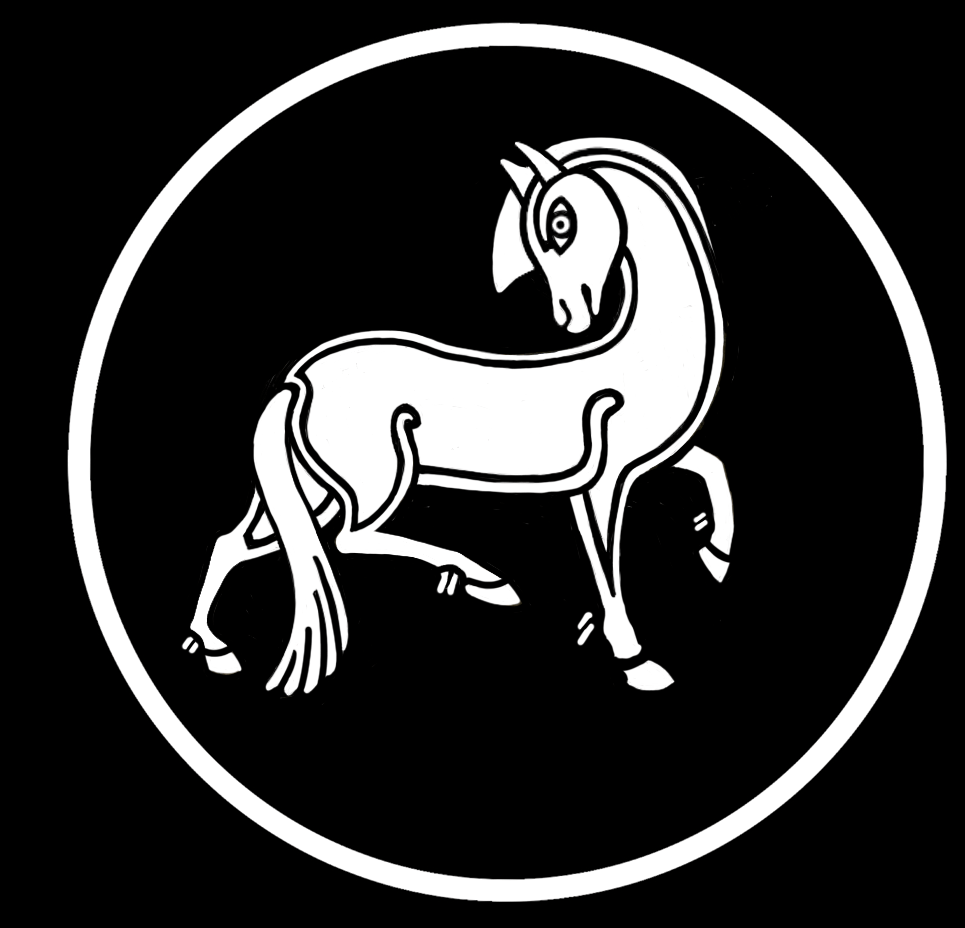
You’ll see I’ve used Pictish-style joint curls but also Lindisfarne Gospels-style inner lines. I liked the combination quite a bit and came back it a few times.
But back to the Aberlemno stone, specifically the front, which is what I’m interested in. Take a look. Note the very Book of Kells-like interlace and, bottom right, the paired ‘seahorses’.
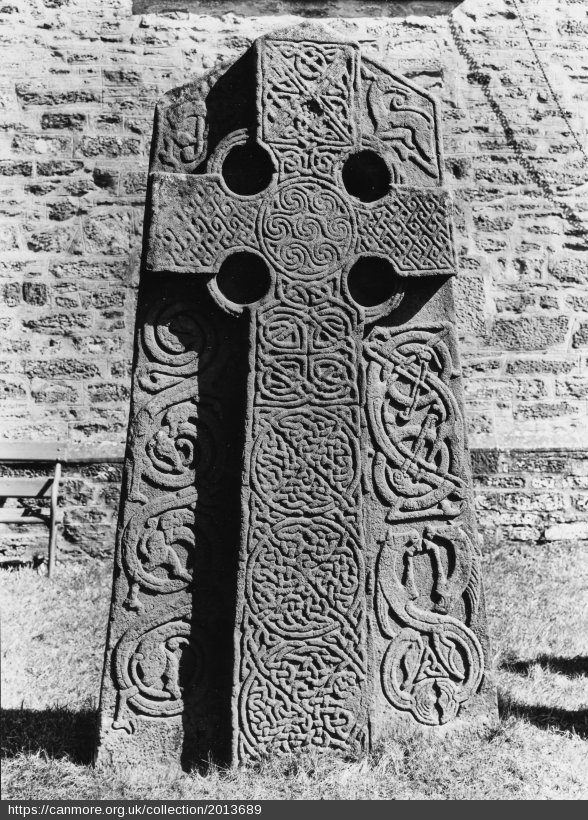
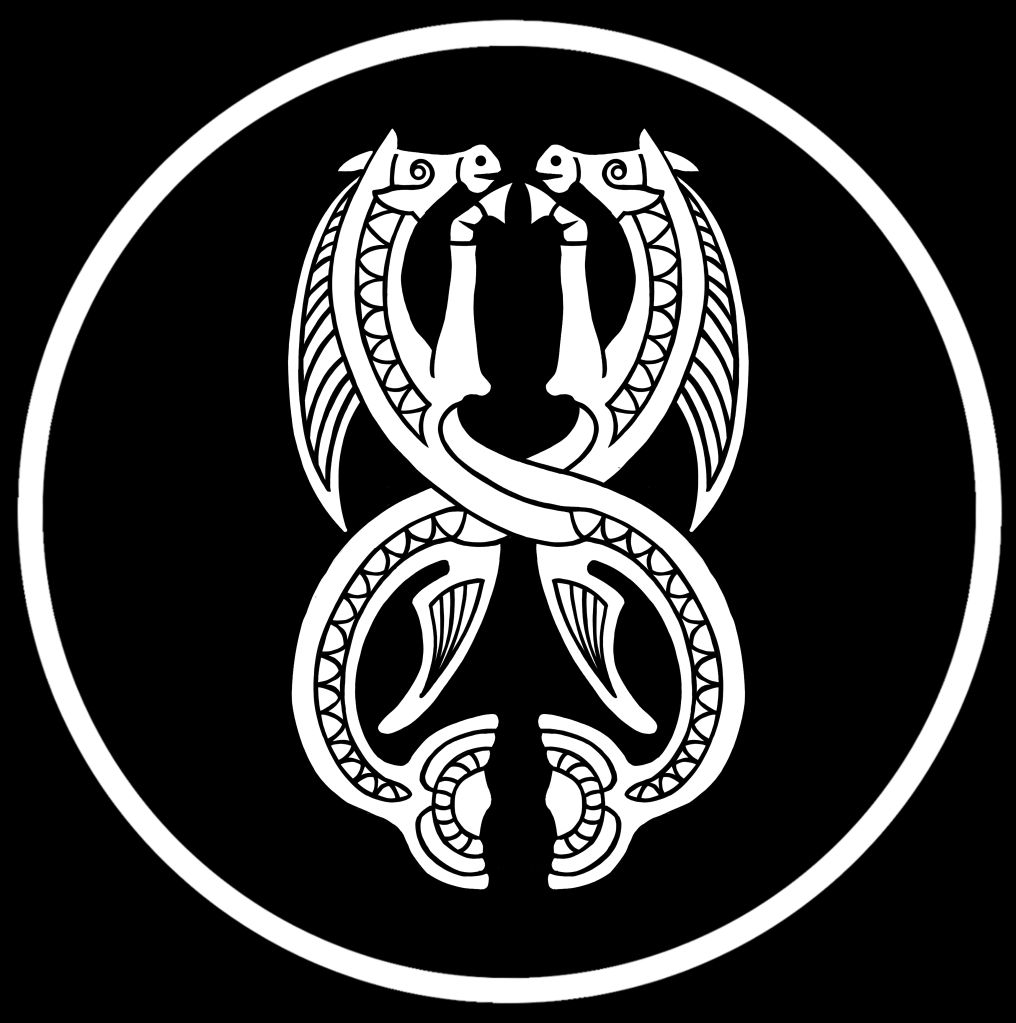
I spent some time studying these. Are they representations of equines that could move under the sea? Of actual seahorses? Or of wholly imaginary beasties? My guess: actual seahorses, only with hooves like terrestrial mammals. In the end it doesn’t really matter. I just really enjoyed the shape and the whimsy. So I had fun recreating them—though because I couldn’t see how the eyes were carved I decided to make them spirals. I doubt this was how they really were but, as I’m doing this whole thing for my own amusement, why not? I also left out the triangle interlace between the fins because it made the whole thing feel cluttered.
Stags were a favourite subject of Pictish carvers—and are among the most visually varied of the animals represented. I’m not familiar enough with either the Pictish stone corpus or cervid species to guess whether all that variation is true to life or just dependent on individual carvers’ preferences. There’s one animal head on an Ardross stone (I’d put it in Category 1) that is often called a deer, but to me it looks more like a seahorse:
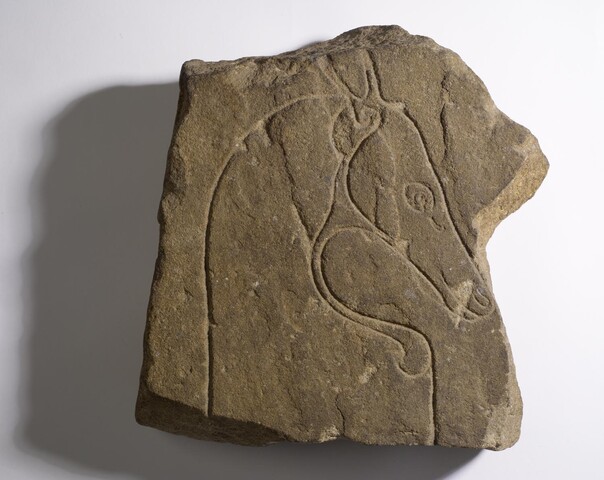
One of the Ardross stones also has a nifty carving of what is probably a wolf, but for now let’s stick to deer.
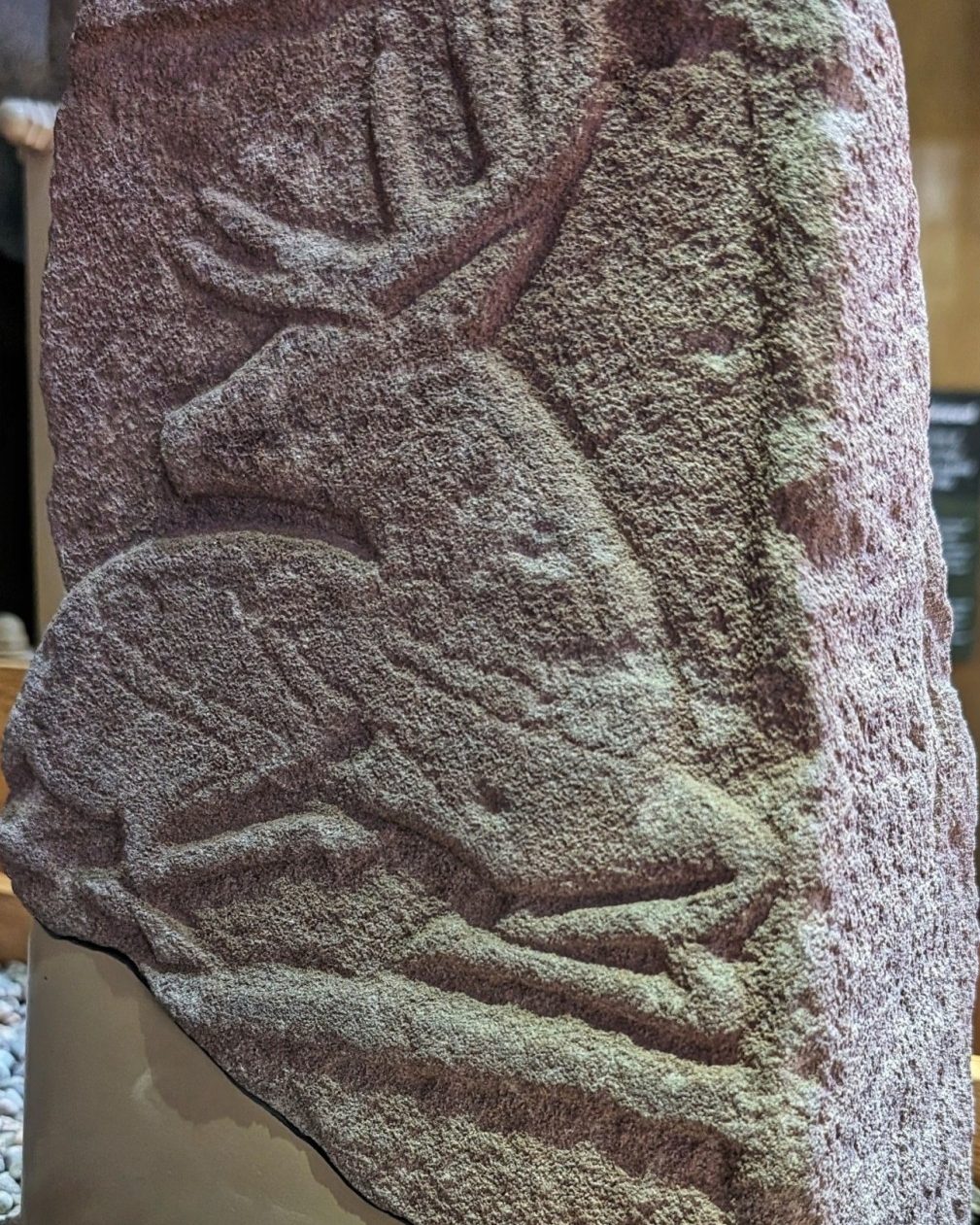
Here’s the St. Vigean’s Stag:
And my version:

I had to make a lot of guesses because the stone is so weathered it’s hard to make out details. Obviousl I’m biased but I like mine better. In fact I enjoyed drawing it so much I copied one of the others, too (this time from the Dunfallandy cross-slab)3:

Another popular animal subject is the boar. Interestingly, it turned out that the boar I’d designed as the Yffing totem didn’t need much updating to become a Pictish boar:

I admit, I like this version—again a mix of Pictish curls and Lindisfarne inner lines—better than my first version.
Many animals that are significant in Hild and Menewood, though, especially those with meaning to Hild herself, aren’t seen in either insular manuscripts or carved stones—at least not from the Early Medieval.4 Those I had to invent whole-cloth. Like this lynx:

I’m not massively happy with this one. It’s too stiff-looking, and the head’s not right. I tried a more realistic lynx head but then it looked less Pictish. Still, I think I prefer it:

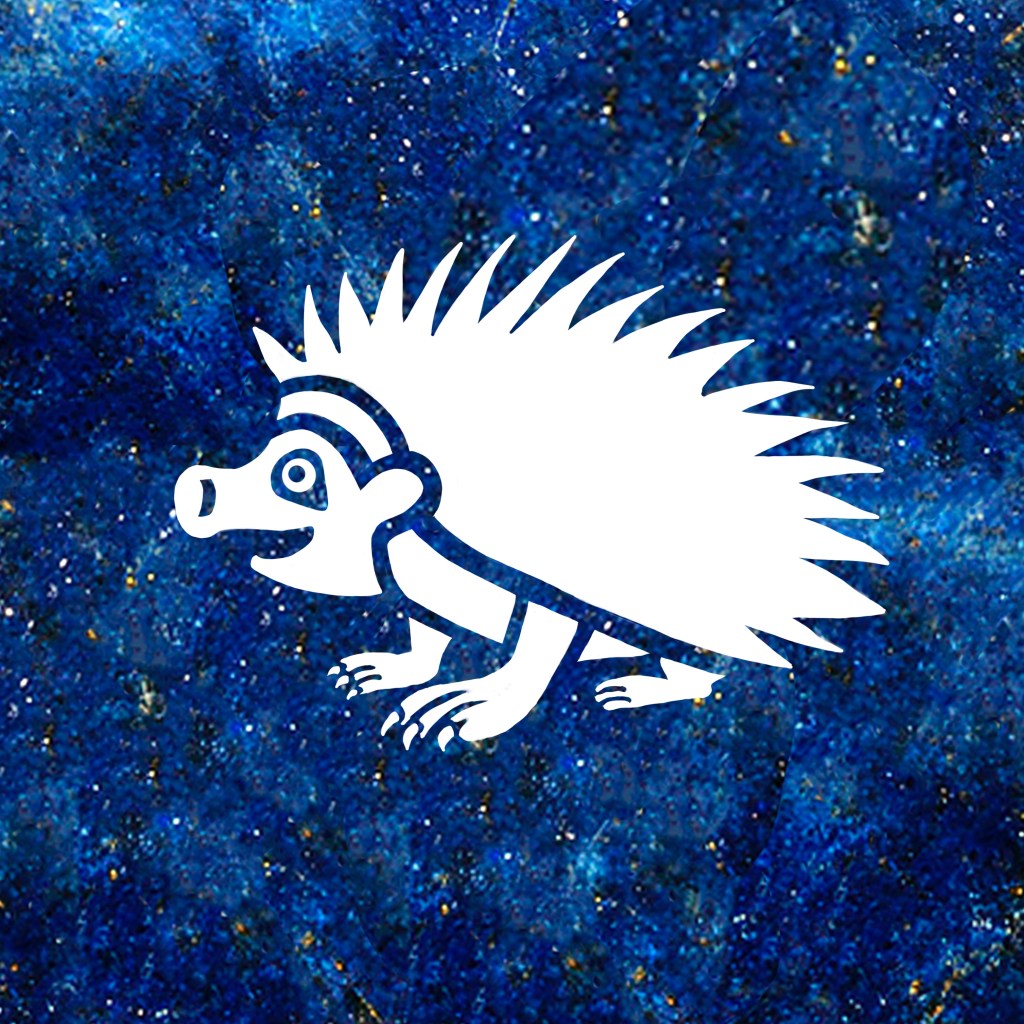
And then a hedgehog—which, yeah, just isn’t Pictish at all. On the other hand, it seems pretty delighted with the world 🙂

I also was delighted, so I decided to put the hedgepig among the stars where its joy and amazement at life the universe and everything could shine forth:5
And it was at this point, finally, having drawn so many of these damn beasts, I thought I might be able to draw some Pictish-style hares.
But that will have to wait for Mad as a March Hare, which goes up tomorrow!
- J. Romilly Allen & J. Anderson, The Early Christian Monuments of Scotland, 2 vols., Balgavies (reprint of the edition Edinburgh 1903), 1993. ↩︎
- A casual search—this really isn’t my area of research and I’m reluctant to get sucked too deep into the Pictish black hole—shows that this might be useful to those who might want more: Stephen T. Driscoll, Jane Geddes & Mark A. Hall (ed.), Pictish progress: new studies on northern Britain in the Middle Ages, Leiden, 2011. ↩︎
- Although, like the Aberlemno cross, it’s obviously slightly later than Category 1 stones, to me it has an earlier feel than Aberlemno ↩︎
- One of my favourites is this GIF version of a 14th-century hedgehog ↩︎
- Well, okay, a slab of lapis lazuli that sort of looks like a starry sky ↩︎


